The Mosaic of the Mind: Finding My Grid By Benjamin Casiano
- Benjamin Casiano Artist

- May 4
- 2 min read
Updated: May 4

The things we see with our minds
For years, I saw a grid where there was none.
It started with a fascination—a "chills up the spine" moment—while standing before the works of Lucian Freud. I didn’t just see a figure; I saw a "micro-abstract" per square inch. I saw a man who didn't just paint a likeness, but who "tiled" a human presence onto the canvas, one obsessive, incremental block at a time. This was my epiphany. It was the bridge between my past as a designer—lost in the mathematical perfection of Photoshop pixels—and my future as a painter.
The Lineage of the Square
I realize now that I have been "absorbing" this grid my entire life. It is in the rhythmic color blocks of Paul Klee, the monumental mosaics of Klimt, and the analytical scrutiny of Chuck Close. But my work isn’t about their perfection; it’s about my own search for answers within the frame.
I've moved from "painting like a camera lens" to "painting like a kaleidoscope." Whether I'm working within a rigid grid or a "shattered stained glass" composition, the goal remains the same: to capture the visceral, raw truth of the subject.
Perfection in the Imperfect
I’ve often been told my subject matter is raw, perhaps even "unflattering" in its honesty. I take that as the highest compliment. I don’t aim for the polished dream-logic of Dalí. My philosophy is simple: With enough imperfections, a work becomes perfect in itself.
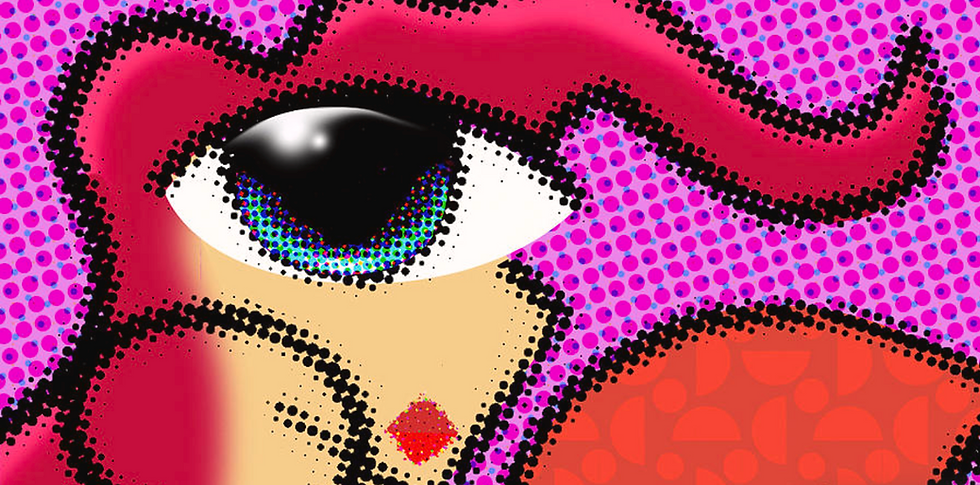
The "one-eye" iconography that defines my work—a style that began as a subconscious "alter ego" before becoming my own physical reality—is the ultimate anchor. It is a direct, unblinking gaze that survives the shattering. By breaking the form into a mosaic of "shards," I'm not destroying the person; I'm reconstructing their energy.
The Kaleidoscope Future
Every square, every jagged edge, and every "unnatural" color is a data point in a larger story. My art is a bridge between the precision of the digital world and the "animalistic" texture of acrylic paint. It is a constant evolution—a mosaic that is never truly finished, but always "perfectly" imperfect.


Comments